

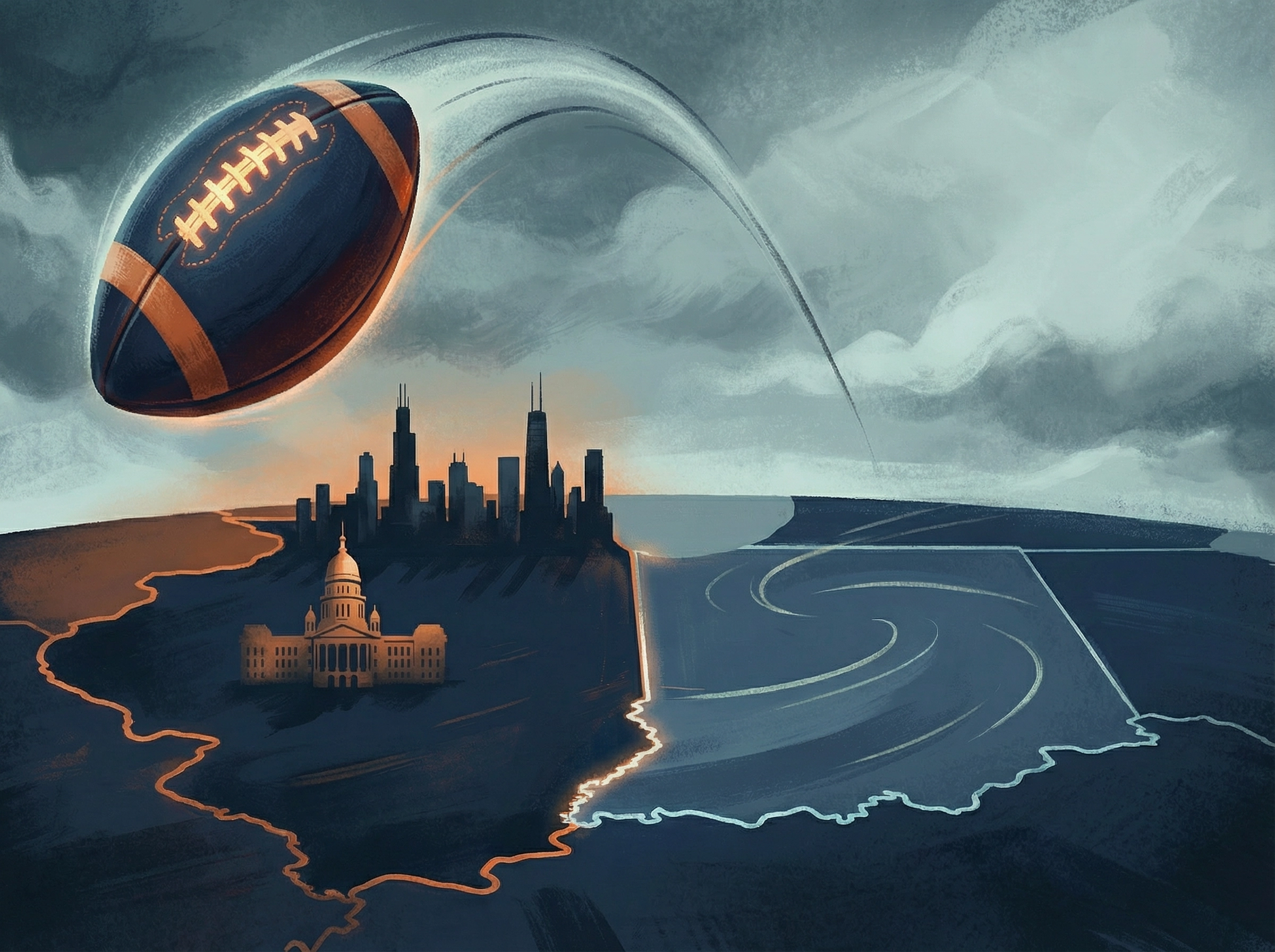
It's the Christmas season, and while many wonder what Santa will leave in their stocking, all Bears fans want is a win against the Packers on Saturday night—and a playoff berth after years of ineptitude. This moment isn't lost on Chicago Bears President Kevin Warren. He sees it as the perfect time to throw a Hail Mary and get the long-stalled Arlington Heights stadium project moving again.
What Happened to the Bears Stadium Bill in Springfield?
The last we left this issue, the Bears were trying to push a bill through the Illinois General Assembly that would provide long-term tax certainty for financing infrastructure improvements around their proposed Arlington Heights stadium. The regular session ended in June with a deal reportedly close but out of time. The veto session came and went with no action.
The media has largely framed the Bears' ask as $855 million in public funding—a characterization Governor Pritzker has leaned into. In October, he drew a hard line against state funding for stadium facilities, though he signaled openness to infrastructure like roads and transit. That distinction matters, but it's been lost in the noise.
Why Are the Bears Threatening to Move to Indiana?
With the legislation stalled and the City of Chicago's bloc of Cook County legislators aligned against them, Warren has chosen a new tactic: divide and conquer. By threatening to abandon current plans and widen the search to include Northwest Indiana, I believe Warren is attempting to unite collar county and downstate legislators behind the Bears' "Super TIF" plan, known as PILOT.
https://twitter.com/GovBraun/status/2001465746283450655?s=20
Here's my theory: With the threat of losing the Bears to Indiana's open arms, legislators outside Chicago might be motivated to let the city deal with the mess it created at Soldier Field—and agree to PILOT. Once there's a majority in favor, real negotiations with Governor Pritzker can truly begin.
Are the Bears Actually Asking for Taxpayer Money?
This is a sticky wicket, and not easily understood. As I covered in detail previously, technically, the Bears are not seeking taxpayer money to build their stadium. However, infrastructure improvements—roads, rail, utilities—must be built to support it. While the Bears need this infrastructure, local businesses and residents benefit too.
These costs can be financed over time at fixed tax rates through a mechanism called Tax Increment Financing, or "TIF." Municipalities across the country use TIFs to make otherwise unfeasible projects work. They’re governed by Joint Review Boards, one of which I am the chairman of in Wisconsin. The business demonstrates that "but for" the TIF, the project wouldn't pencil out. Then the municipality and affected taxing bodies (most prominently school districts) agree to a tax schedule.
TIFs are ripe for abuse, and Illinois has plenty of examples of failed ones. But the Bears and Arlington Heights have already started down this path, securing an agreement with the school districts a year ago.
What Is PILOT and Why Do the Bears Need It?
The idea being floated is that a project this size needs more than a TIF can offer. Enter PILOT—Payment In Lieu Of Taxes. It's not a new concept: New York used PILOT bonds to build Yankee Stadium and Citi Field, and Nashville is using them for the Titans' new $2.1 billion home. What's different here is the timeline. Illinois TIFs max out at 23 years; the Bears want 40, locked in from the start. That's the "mega-project" ask—and why I call it a "Super TIF."
This raises a few questions:
Why Did Kevin Warren Make This Announcement Now?
The Bears play the Packers Saturday with the division on the line. At 10-4, they have a real shot at the playoffs and have captivated Bears fans everywhere after years of futility. What better time to cast the state as the villain blocking a new stadium? Threaten to lose the Bears to Indiana. It's ham-fisted, but I get the logic.
How Does the Indiana Threat Pressure Illinois Legislators?
Families of Bears fans are about to gather for the holidays, with playoff football as the backdrop. Talk will inevitably turn to when the new stadium will ever get built. Fear of a move to Indiana creeps into the hearts of fans nowhere near the state line—or those just nostalgic enough to want the team to stay in Illinois. (The Giants and Jets play in New Jersey, but I digress.)
Everyone goes home grumbling. Come the new year, they're motivated to let their state representative know what they think about bailing out Chicago yet again.
Why Is This So Important for the Bears Stadium?
Tax certainty. Funding an NFL stadium involves multiple parties—minority stakeholders, lenders, the NFL itself. They all want assurance the project will succeed, and that means knowing what the taxes will be.
Cook County, which effectively operates as an extension of Chicago's political machine, has already fired shots. The Cook County Assessor assessed the empty, razed racetrack property at $197 million—almost six times its prior $33.5 million valuation—as if a stadium already stood on it. A clear warning of the punishment to come for jilting Chicago. That kind of instability scares investors. Will it continue? Is this situation stable, or will the political infighting never end?
Guy's Final Take: The Bears' Indiana Bluff Is Backfiring
I understand the motivation behind this move. But in typical Bears fashion, the execution has gone sideways. In fact, it appears to be blowing up in their face. A spokesperson for Governor Pritzker called the Indiana threat "a startling slap in the face to all the beloved and loyal fans who have been rallying around the team during this strong season." That's not the reaction you want.
Because this issue is nuanced and hard to explain, it's easy to paint the Bears as greedy billionaires (they’re not) demanding taxpayer money for their stadium. That's not quite true—but it's true enough to inflame passions.
The Real Mistake: Building in Cook County
The biggest strategic mistake was made before Warren arrived: choosing to build in Cook County. The Arlington Park property is undeniably ideal for this project, but it's a political nuclear bomb. Had the Bears picked a site in another county, they'd still be fighting Chicago's political forces—but it would be a more manageable fight. Inside Cook County, Chicago has much bigger teeth.
What the Bears Should Be Saying About Soldier Field
What the Bears should be doing is making the case for how badly the city bungled Soldier Field. They tried to work with Chicago once before, and what they got was a UFO landed on a historic colonnaded bowl—with not enough bathrooms. Worse, the Illinois Sports Facilities Authority—the state agency created in 1987 to keep the White Sox from fleeing to Florida and later tasked with the Soldier Field renovation—has collected over $1 billion in hotel taxes since 1989, yet still owes $356 million on Soldier Field and $51 million on the White Sox stadium. The city has had to divert $52 million from its own coffers since 2022 to cover shortfalls, with sports financing expert Marc Ganis calling the arrangement's collapse evidence of "patronage within the city." That argument would have traction.
Instead, they've played right into the hands of an inept mayor and city government. Nobody is going to read a lengthy open letter. They're going to see "Bears want taxpayer money" and scream robbery—whether it's accurate or not. Public sentiment swings negative, and now you've got a massive mess to clean up.
So all I can say is: get a portable urinal and Bear Down. The Bears aren't moving anytime soon.

Comments