

Originally posted as an X article on my account.
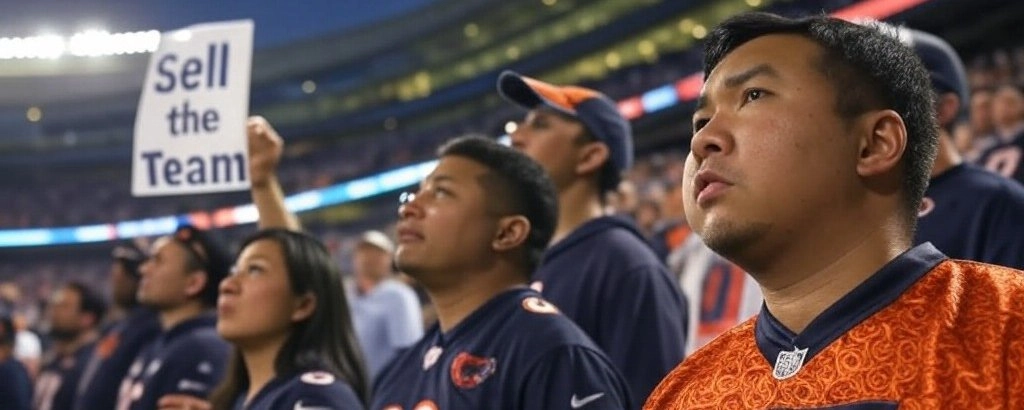
The faithful gathered at Soldier Field on the Thursday after Christmas, an apt description for fans braving the fog and drizzle to witness a 4-12 team endure its 10th consecutive loss in yet another dismal season. As the game staggered toward its dreary conclusion, chants began to echo through the damp winter air. Crisp and clear for all (including Amazon Prime's broadcast microphones) to hear, the cry was unmistakable: “Sell the team.”
https://twitter.com/jacobinfante24/status/1872489435222462840?s=20
It was the final home game of the season (mercifully, the last game will put this miserable campaign to rest next week against the hated Green Bay Packers at Lambeau Field), and the scene at Soldier Field felt like a fittingly bleak end to a hopeless year. The moment brought to mind Yeats’ haunting phrase: “what rough beast slouches toward Bethlehem to be born?” The chants of “sell the team” weren’t just an expression of frustration — they were a stark reflection of the mounting discontent among fans, aimed not at the players but at the McCaskey family and their hold over this storied franchise. This frustration, however, is just the tip of the iceberg. The ownership of the Chicago Bears is steeped in a legacy that stretches back over a century, intertwined with the NFL’s very origins and marked by complex family dynamics, financial entanglements, and league rules designed to preserve family-run franchises. In this series, we’ll peel back the layers of the Halas-McCaskey family’s ownership, exploring the triumphs, tragedies, and controversies that have defined their stewardship of one of football’s most storied teams. From George Halas’ visionary leadership to the current questions surrounding the team’s future, we aim to uncover what it truly means to own the Chicago Bears.
George Halas’ Legacy: Keeping the Bears in the Family

Then NFL Commissioner Pete Rozelle with George S. Halas
George Halas meticulously structured the Bears' ownership to remain in the family for generations.
Virginia McCaskey controls the Halas Family Trust, which includes 69% of the team’s shares split among family members.
NFL rules require a single family to retain at least 30% ownership to keep the team under family control.
Non-family shareholders, like Patrick Ryan, have rights of first refusal, making a sale even more complicated.
Any sale of the Bears would require extraordinary coordination among dozens of family members and external shareholders.
For frustrated fans chanting “sell the team,” the reality is far more complicated. George Halas himself ensured that the Chicago Bears would remain a family legacy, structuring ownership through a complex network of trusts and agreements, all designed to keep the franchise within the Halas-McCaskey family. Virginia McCaskey, the matriarch of the family, holds voting control of the Halas Family Trust, which collectively owns 69% of the team. Even if a majority of family members wanted to sell, the NFL’s strict rules on family ownership require at least 30% of the franchise to remain with a single family. Adding to the complexity, minority shareholders like Patrick Ryan hold rights of first refusal, creating further obstacles to any potential sale. This intricate system was no accident — it reflects George Halas’ vision of keeping the Bears in the family and protecting his legacy for generations.
From Daughter to Matriarch: Virginia McCaskey's Unexpected Role
George Halas' Final Play: Keeping the Bears in the Family
George Halas was as determined in the boardroom as he was on the gridiron. His unwavering desire was for the Chicago Bears to remain within the family. Shortly before his death, Halas orchestrated a series of strategic moves to ensure his legacy endured.
We’ll explore the intricate legal and financial implications of the Bears’ ownership structure in a future deep dive, but it’s essential to understand one key move that defined the team’s governance. In 1981, George Halas Sr. reorganized the Chicago Bears as a Delaware corporation, forming the Chicago Bears Football Club, Inc. This shift leveraged Delaware’s favorable corporate governance laws and allowed Halas to issue stock in the new entity to mimic the team’s existing structure — with singular leadership at the top.
The reorganization also included the creation of the Halas Family Holding Company (HFHC), another Delaware entity, through which Halas exchanged his personal shares for preferred stock and a debenture. This dual-class stock arrangement ensured that decision-making power remained consolidated, laying the groundwork for the Bears to remain a family-run enterprise.
Halas' foresight in making this move not only reinforced his desire for centralized control but also ensured a legacy that balanced family interests with the operational stability of the team. The issue was this structure was created for his son, George "Mugs" Halas, Jr., who would pass away before his father in 1979.
From Daughter to Matriarch: Virginia McCaskey’s Unexpected Role
With Mugs gone, the singular role of owning and overseeing the Bears fell to Halas' daughter, Virginia. The transition was as unexpected as it was transformative. In a scenario reminiscent of King George VI stepping in after his brother’s abdication, Virginia assumed a role she never anticipated.
On October 31, 1983, George Halas Sr. passed away. Just a day later, Virginia officially took ownership of the team, calling the responsibility a “wonderful kind of burden.” Halas’ meticulous estate planning had ensured that the Bears would stay in the family, but it also sparked internal family struggles.
Halas’ creation of stock and trusts was designed to consolidate control of the team under one leader while limiting the ability of minority owners to sell their shares. These provisions would come to light in a lawsuit brought by Mugs’ children, Christine and Stephen, exposing a dark chapter in the Bears’ history.
Interestingly, the NFL’s current ownership rules reflect this same philosophy of centralized control, shaped in part by family-run franchises like the Bears. Originally requiring a majority stake, today’s rules mandate that a single family maintain at least a 30% ownership stake in the team. This model — rooted in Halas’ vision — has become a cornerstone of the NFL’s governance, ensuring stability while fostering generational family ownership.
A Man’s World, but a Woman’s Reign
“I don’t look to be in the spotlight. I think it’s a man’s world as far as the Chicago Bears are concerned.” – Virginia McCaskey
Virginia McCaskey’s approach to running the Bears reflects her belief that leadership of the team is “a man’s world.” That man, first her husband Ed McCaskey, then her son Michael, and now her son George, has always been the public face of the organization. But make no mistake — while the Chicago Bears may be a man’s world, the reins have always been firmly in the hands of the First Lady of the NFL, Virginia McCaskey.
Virginia McCaskey’s leadership has preserved the family’s control of the Bears for decades, but it’s the structure George Halas put in place that ensures the team’s ties to the McCaskey family remain ironclad. The Bears' ownership structure, shaped by Halas’ meticulous planning, not only reflects his desire for singular leadership but also establishes a framework that makes selling the team a near-impossible feat.
At the heart of this complexity are the stock arrangements Halas created in 1981 when he reorganized the Bears into a Delaware corporation. This move ensured voting power remained centralized, enabling Virginia to maintain control of the team while granting minority stakes to the grandchildren. However, these shares are bound by strict rights of first refusal, meaning any sale of stock requires the current owners to approve the transaction and often exercise the option to buy those shares themselves.
These interlocking rights, along with Virginia’s voting power over her grandchildren’s shares, have not only made it difficult for minority stakeholders to sell but also ensure that any attempt to sell the team as a whole would require unanimous agreement from all stakeholders — a virtually unattainable consensus.
This intricate structure, while preserving the family’s legacy, also creates challenges for future generations. As ownership stakes become further diluted across dozens of heirs, the difficulty in achieving consensus on major decisions will only grow. The result is a team that, while financially valuable, operates with unique constraints that make it more likely to remain in the family than to be sold outright.
Reluctant Leadership: George’s Turn at the Helm
Like his mother before him, George McCaskey was thrust reluctantly into his role as Chairman of the Chicago Bears. After Michael McCaskey’s tenure ended in 2011, George stepped forward to lead a team he had always supported but never envisioned running. This sense of duty mirrors Virginia’s own journey, one that began unexpectedly in 1983 when she inherited control of the team after her father’s passing.
While George serves as the public face of the Bears, the true power remains with Virginia, who controls the critical voting block that keeps the team firmly in family hands. This centralized authority ensures that Virginia’s decisions dictate the franchise's present direction. However, the intricate ownership structure that George Halas meticulously designed guarantees that this control will extend far beyond her passing. The mechanisms Halas put in place — intended to ensure the Bears remain a family legacy — create a framework that could both preserve and complicate the team's future.
This brings us to the complex web of ownership that has been woven over nearly 100 years. From Halas’ original vision to the reorganization of the team in the 1980s, the Bears' ownership history provides a fascinating and layered story of legacy, loyalty, and the challenges of keeping an iconic franchise "in the family."
What Comes Next
In our next article, we’ll dive into the structure George Halas established to ensure the Bears stayed within the family, examining the complex web of ownership that governs the team. From the stock reorganization in 1981 to the unique rights of first refusal, we’ll uncover how these mechanisms were designed to safeguard the franchise from external influence.
In the following installment, we’ll explore the succession planning required by the NFL and the potential implications for the McCaskey family when Virginia’s era eventually ends. How will the family manage the challenges of consolidated control, generational shifts, and NFL compliance? Stay tuned as we uncover the intricate details behind one of the league’s most storied franchises.

Comments